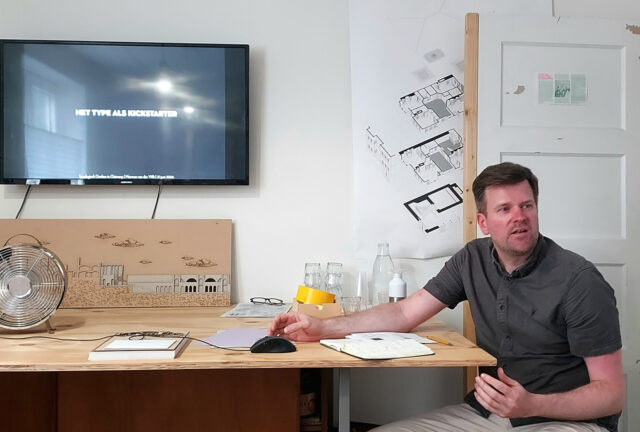
22 June 2026 – Midsummer’s Day, sweltering hot, a former neighbourhood shop in a residential block designed by J.J.P. Oud in Rotterdam Bospolder: the Typological Thinking in Design meeting took place in the so-called Oud House. Students and recent graduates came together to discuss their research from a typological perspective. They presented research and designs based on historical architecture across different countries. The aim of the event was to exchange knowledge and methods and to initiate a dialogue between different schools and design practices.
Hans van der Heijden gave an introduction to the concept of typology as he uses it in his teaching at the RAvB. Harmen van der Wilt spoke about his final-year project, in which he adapted the palazzotype to his own vision. He concluded his talk with two propositions:
Typology should not be understood as a hierarchy of better or worse solutions. Every type has its own logic.
Of the stacked housing types, the palazzo type is the most flexible.
He demonstrated quite convincingly that, whilst conventional Dutch housing types – the gallery block and the tower block – do indeed feature communal spaces, these are not firmly anchored within the typology. A palazzo, on the one hand, cannot by definition exist without a communal atrium. Collectivity is embedded in the type and is a prerequisite for its success. On the other hand, it appears to be a type that adapts effortlessly to various urban environments: Renaissance Rome and Florence, the 18th-century speculative city of Naples, the 19th-century speculative city of Budapest and, why not, the 21st-century urban expansion of Utrecht Terwijde.
The event was organised by Ceylan Kılıç and Lennart Arpots. Other speakers included: Nigora Atta, Naomi Codée, Ceylan Kılıç, Matteo Rizzo and Leyla Hepsaydır. Justin Agyin acted as moderator. It was hot, but J.J.P. Oud might have been pleased. The exchange of thought was worth the effort, thanks to all.